


A Carbon-Scored Bond Mandate

Now operating under the Richelieu Gestion brand, this mandate was originally developed by Hugau Gestion in partnership with Axylia. Launched in October 2023, it runs to a 2028 maturity and combines rigorous credit selection with a forward-looking carbon scoring methodology.
The Investment Case
The bond market context that gave birth to this mandate was clear: rising rates in 2022–2023 had reopened yield opportunities across Investment Grade corporate debt, after years of compressed spreads. At the same time, institutional investors were increasingly required to account for carbon risk in their portfolios. Hugau Axylia Carbone 2028 was designed to sit at the intersection of those two demands — capturing the yield available in IG credit while systematically selecting companies best positioned to absorb the cost of the carbon transition.
The mandate targets a net annual return of 4%, with volatility below 5%, over a five-year investment horizon to its 2028 maturity.
A Four-Step Selection Process
What distinguishes this mandate is the structured, sequential filter applied to define the investable universe. Rather than treating ESG as a scoring overlay grafted onto a pre-built portfolio, Hugau Gestion and Axylia integrated carbon criteria directly into the construction process.
Step 1 — Define the universe. Hugau Gestion establishes the investment perimeter: European Investment Grade corporate bonds, rated between AAA and BBB– by agencies such as Standard & Poor's. This segment is characterised by strong credit quality and low default probability, as opposed to High Yield bonds (rated BB+ and below), which carry higher risk and are commensurately more rewarding.
Step 2 — Apply the Carbon Score filter. Axylia, the extra-financial analysis partner, screens the remaining universe for companies capable of absorbing their implied carbon bill as evaluated in 2020. The carbon score — rated A, B or C — reflects the ratio of a company's EBITDA to its theoretical carbon liability. Companies that cannot cover this cost are excluded, as are issuers operating in sectors deemed structurally incompatible with the mandate's values: alcohol, defence, tobacco, gambling, and care homes.
Step 3 — Select for carbon trajectory. Passing the initial threshold is not enough. Axylia then refines the selection by identifying companies whose Carbon Score is projected to improve the most by 2028. This forward-looking dynamic score is the mandate's true differentiating feature: it rewards companies actively reducing their carbon intensity, not merely those starting from a favourable base.
Step 4 — Financial analysis. Only after clearing the carbon filters does Hugau Gestion apply its credit analysis: cash flow generation, balance sheet quality, refinancing risk, and pricing versus market intermediaries. The final portfolio comprises approximately 40 positions.
Portfolio Characteristics
The fund invests exclusively in senior unsecured Investment Grade corporate bonds, the segment that occupies an intermediate position in the capital structure — subordinated to secured debt and government bonds, but senior to hybrid instruments and convertibles. Issuers may be domiciled anywhere in Europe and may issue in currencies other than the euro, provided exchange rate risk is fully hedged.
The portfolio of approximately 40 issuers spans a broad cross-section of European industry. From the preliminary inventory presented in February 2023, names include EssilorLuxottica, Schneider Electric, Capgemini, Vinci, Veolia, EDF, L'Air Liquide, ASML, Siemens, Iberdrola, Enel, Nokia, and LVMH, among others — a list that reflects both the breadth of the screened universe and the balance sought between sectors and geographies.
The Carbon Score : what It Actually Measures
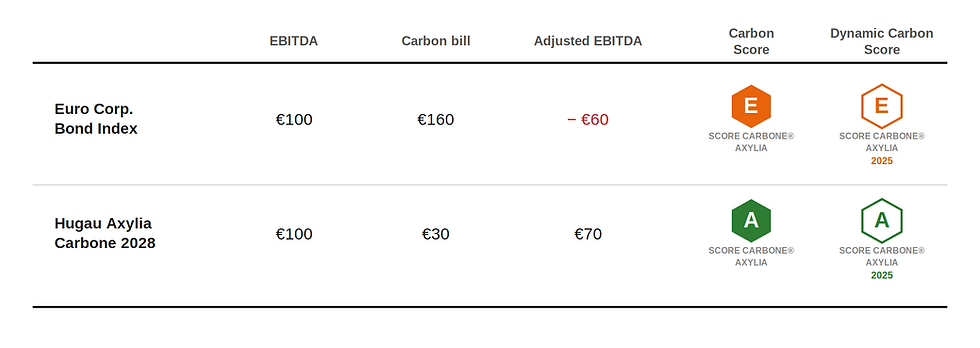
The mandate's extra-financial performance is built on a precise and transparent calculation. The core indicator is the carbon bill as a percentage of EBITDA.
The comparison presented in the fund's documentation is stark. For the benchmark European corporate bond index, the implied carbon liability amounts to €160 for every €100 of EBITDA generated — meaning the average constituent, if fully priced for its carbon externality, would operate at a loss on this measure. The Hugau Axylia Carbone 2028 portfolio, by contrast, carries a carbon bill of just €30 per €100 of EBITDA, leaving an adjusted EBITDA of €70. This fivefold improvement over the index is the fund's headline climate argument — and its demonstration that carbon-aware selection reduces long-term financial risk, beyond mere optics.
Positioning and Caveats
The mandate's logic is coherent and its methodology more rigorous than many ESG-labelled products that apply superficial exclusions without integrating carbon cost into the financial model. The use of a dynamic carbon score — penalising stagnation and rewarding trajectory — is a meaningful step beyond static best-in-class approaches.
That said, several points deserve attention. The initial inventory runs to well over 100 candidate names before the financial selection reduces the portfolio to 40; how much the carbon filter genuinely constrains the final portfolio — rather than serving as a marketing narrative applied to a credit-driven selection — is a question that warrants ongoing transparency. The 4% net return target, reasonable in a rising-rate environment as of early 2023, depends heavily on deployment timing and the evolution of spreads over the fund's life. And the high entry and exit fees, while structurally justified, limit the mandate's accessibility for smaller investors with uncertain liquidity needs.
Hugau Gestion's track record in credit management — evidenced by Quantalys five-star ratings on Hugau Obli 3-5 and a Refinitiv Lipper Fund Award for Hugau Rendement Responsable — provides a credible foundation. The transition to Richelieu Gestion adds distribution capacity and institutional reach to a strategy that was otherwise confined to a boutique platform.
This article is based on the pitch book presented by Hugau Gestion in February 2023. It describes the fund as originally designed; investors are invited to consult the documentation currently in force under the Richelieu Gestion brand for up-to-date terms and performance data.


Comments